Ventilation Problems Old Flats Torrevieja: How to Fix
Introduction
Poor ventilation is one of the most common problems I encounter when renovating bathrooms in older flats across Torrevieja, Orihuela Costa, La Zenia, Playa Flamenca and Cabo Roig. Many apartments built in the 1970s, 80s and 90s were designed with minimal airflow in mind, and decades of coastal humidity have left bathrooms prone to mould, peeling paint and persistent damp smells. Understanding ventilation problems in old flats in Torrevieja and how to solve them during a renovation can transform a musty, uncomfortable bathroom into a fresh, healthy space that lasts for years.
Why Older Flats in Torrevieja Suffer from Ventilation Problems
Most older buildings along the Costa Blanca were constructed during a period when building regulations were less stringent and mechanical ventilation was rarely considered necessary. Developers assumed that opening a window would be enough, but in practice many bathrooms in these flats have only a small, fixed louvre or no external window at all.
The coastal climate compounds the issue. Torrevieja and Orihuela Costa sit right on the Mediterranean, so humidity levels stay high year-round, especially in autumn and winter. When warm, moist air from showers and baths meets cool tile surfaces, condensation forms quickly. Without adequate ventilation to expel that moisture, it settles on walls, ceilings and grout lines, creating the perfect environment for mould and mildew.
Another factor is the way older flats were laid out. Interior bathrooms—those without any external wall—are common in apartment blocks from that era. The original ventilation shaft, if it exists at all, is often shared between multiple units and clogged with decades of dust, debris and sometimes even old nests. I've opened ceiling panels in buildings around Playa Flamenca and found communal ducts that haven't been cleaned since the day they were installed.
Finally, many owners have made the problem worse over the years by blocking vents, sealing gaps around doors for draught-proofing, or replacing original windows with modern double-glazing that creates an airtight seal. All of these changes trap moisture inside the bathroom with no way out.
Recognising the Signs of Poor Ventilation During Your Visit
Before you start planning a renovation, it's worth spending a few minutes identifying the specific ventilation issues in your flat. Walk into the bathroom after someone has showered and note how long the mirror stays fogged and whether you can smell dampness. Check the ceiling corners and the grout lines around the shower for black or green spots—classic signs of mould growth.
Look at the paint or plaster on the ceiling. If it's flaking, bubbling or discoloured, moisture is almost certainly trapped behind the surface. In many older Torrevieja flats I've worked on, the ceiling plaster has become soft and spongy because years of steam have soaked into it with nowhere to escape.
Open any existing ventilation grilles and peer inside with a torch. You'll often find a thick layer of dust or, in communal shafts, evidence that the duct is partially blocked. If your bathroom has a small window, check whether it actually opens fully or just has a fixed louvre that lets in a trickle of air. Many of these old aluminium windows have corroded hinges that no longer function.
Finally, check the gap under the bathroom door. Building standards now recommend at least a 15–20 mm gap to allow air to flow in from the rest of the flat and out through the extractor or window. Older doors often sit flush to the floor or have a tiny 5 mm gap, which chokes off the supply of fresh air even if you install a powerful fan.
Free visit and quote, fixed price in writing and a guarantee on the works.
How to Fix Ventilation Problems During a Bathroom Renovation
Installing a Mechanical Extractor Fan
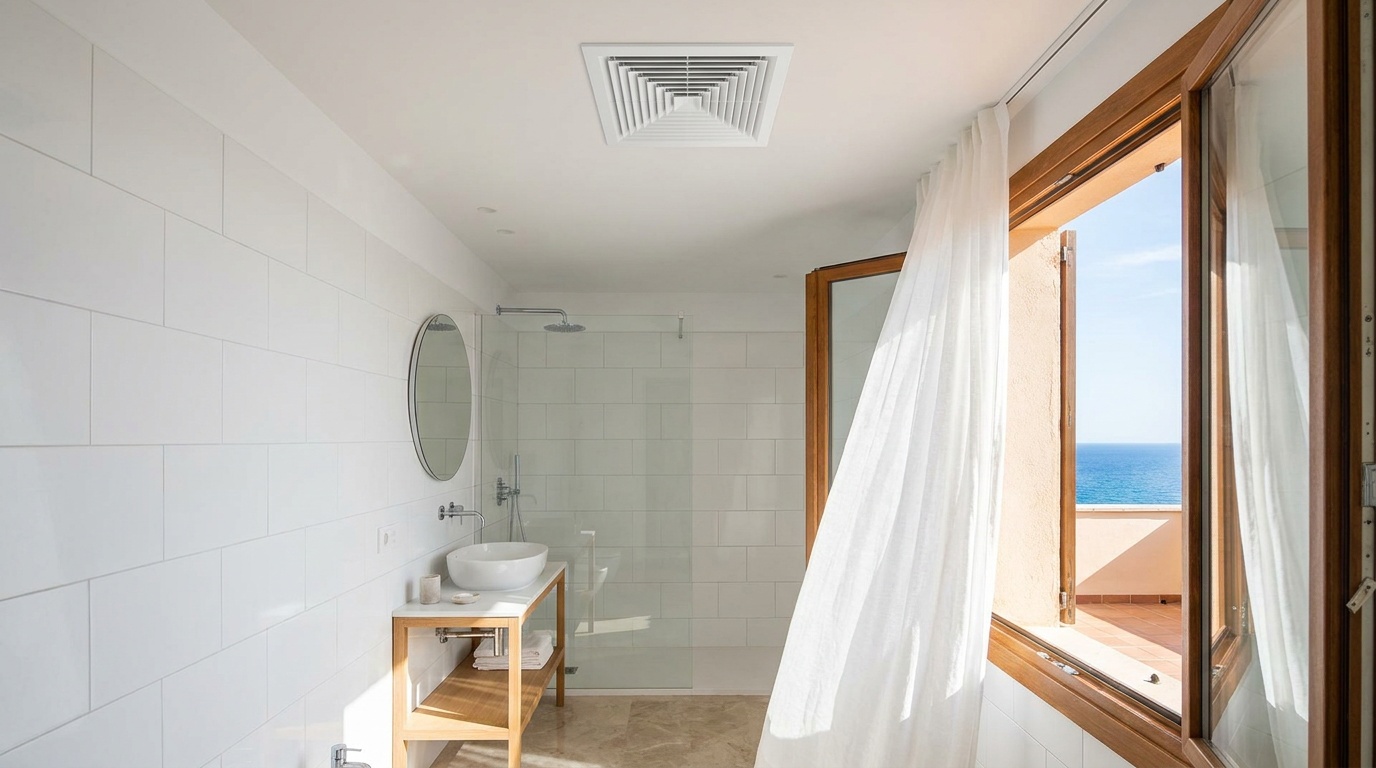
The single most effective solution for ventilation problems in old flats in Torrevieja is to install a proper mechanical extractor fan. If your bathroom has no external window, or if the window is too small to provide adequate airflow, a fan is essential.
There are two main types: inline fans and wall- or ceiling-mounted fans. Inline fans sit inside the ductwork—usually in the ceiling void or a cupboard—and are quieter because the motor is hidden away from the bathroom itself. They're ideal if you have access to a communal ventilation shaft or can run a duct to an external wall. Wall- or ceiling-mounted fans are simpler to install and work well if you can duct directly outside or into an existing shaft.
When choosing a fan, pay attention to the extraction rate, measured in cubic metres per hour (m³/h). For a standard bathroom of around 5–6 m², you'll want a fan rated for at least 80–100 m³/h. Larger bathrooms or those with a bath and separate shower need more capacity. I usually recommend models with a built-in humidistat, which switches the fan on automatically when moisture levels rise, and a timer that keeps it running for 10–20 minutes after you leave the room to clear residual steam.
The installation sequence depends on your flat's layout. If there's a communal shaft, we cut an opening in the ceiling, fit a rigid or flexible duct from the fan to the shaft, and seal all joints with aluminium tape to prevent air leaks. If there's no shaft, we core-drill through an external wall—usually above the false ceiling—and fit a cowled vent on the outside to stop rain and wind from entering. The whole process typically takes half a day, including making good the plaster and painting.
One common mistake is installing the fan too close to the shower. If the fan is directly above the shower head, it draws steam across the room, spreading moisture over a wider area before it's extracted. Position the fan on the opposite side of the room or above the door so it pulls air across the entire space.
Improving Natural Ventilation with Windows and Vents
If your bathroom does have an external window, make the most of it. I've renovated dozens of flats in Orihuela Costa where the original aluminium window was rusted shut or had a broken catch. Replacing it with a modern PVC window that includes a secure night-vent position allows you to leave it open a crack for continuous background ventilation without compromising security.
For bathrooms with only a small fixed louvre, consider enlarging the opening if the community of owners permits it. This usually requires approval because you're altering the building's facade, but in my experience most communities in Torrevieja and the surrounding towns are pragmatic about improvements that prevent damp damage. Alternatively, you can install a larger adjustable louvre or a hit-and-miss vent that gives you more control over airflow.
Some older buildings have internal light wells or patios that serve as a secondary ventilation route. If your bathroom backs onto one of these, you may be able to install a small window or vent grille that draws air from the light well. It's not as effective as venting directly outside, but it's better than nothing and avoids the need to connect to a communal shaft.
Don't forget passive vents in the door or wall. A simple transfer grille fitted into the top of the bathroom door or the wall above it allows air to flow in from the hallway, creating a through-draught when the extractor fan runs. These grilles cost very little and make a noticeable difference to airflow, especially in interior bathrooms.
Choosing Materials That Resist Moisture and Mould
Even with good ventilation, a bathroom in a humid coastal climate needs materials that can handle occasional condensation without deteriorating. During the renovation, I always recommend porcelain tiles for walls and floors rather than ceramic. Porcelain has a much lower water absorption rate—typically less than 0.5%—so it doesn't harbour moisture that can seep into the substrate and cause problems later.
For ceilings, standard gypsum plaster painted with ordinary emulsion is a recipe for trouble in a poorly ventilated bathroom. Instead, use moisture-resistant plasterboard (the green or blue type) and finish it with a specialist bathroom paint that contains anti-mould additives. Alternatively, consider a suspended PVC panel ceiling, which is completely waterproof and hides the extractor duct neatly. These panels are common in newer developments around Cabo Roig and are easy to maintain.
Grout is another weak point. Standard cement grout is porous and stains easily in damp conditions. Epoxy grout costs more and takes longer to apply, but it's totally waterproof and resists mould growth much better. If epoxy is outside your budget, at least use a high-quality cement grout mixed with a latex additive and seal it properly once it's cured.
Microcement is popular for creating a seamless, modern look on walls and floors, but it must be applied correctly in a bathroom. The substrate needs to be bone-dry before application, and the final sealer must be a high-performance product designed for wet areas. I've seen microcement installations in La Zenia flats where the applicator skipped the proper prep, and within a year moisture was wicking up from below, causing the coating to delaminate.
Addressing Structural Issues That Worsen Ventilation
Sometimes poor ventilation is a symptom of deeper structural problems. In older blocks around Torrevieja, I often find that external walls have no cavity or insulation, so they act as a cold bridge. When warm, humid air inside the bathroom meets the cold wall surface, condensation forms even if the extractor fan is running.
Adding internal insulation during a renovation can help, but it's a bigger job. You fix insulation boards—typically extruded polystyrene or polyisocyanurate foam—to the wall, then overlay them with moisture-resistant plasterboard or tile backer board before tiling. This raises the surface temperature of the wall and reduces condensation. It also steals 5–8 cm from the room, which can be a problem in a small bathroom, so it's a trade-off.
Another issue is rising damp or water ingress from the flat above. If the bathroom floor or walls are persistently wet despite good ventilation, investigate the source. Leaking waste pipes hidden in the floor void are common in buildings from the 1980s, when plastic fittings were just coming into use and weren't always installed properly. Fixing these leaks is essential before you renovate, otherwise you'll just trap the problem behind new tiles.
In buildings with communal ventilation shafts, the shaft itself may need cleaning or repair. This is technically the community's responsibility, but in practice many communities in Orihuela Costa and Playa Flamenca are slow to act. If you're planning a renovation, it's worth raising the issue at a community meeting and offering to share the cost of having the shaft professionally cleaned and inspected. A blocked or poorly maintained shaft will undermine even the best extractor fan.
Practical Steps and Timeline for a Ventilation-Focused Bathroom Renovation
Let's walk through a typical renovation sequence for an older flat in Torrevieja with serious ventilation problems. This example assumes an interior bathroom of about 5 m² with no window and a non-functioning communal ventilation shaft.
Day 1: Strip-out and assessment. We remove the old tiles, sanitaryware, and any damaged plaster or plasterboard. Once the walls and ceiling are bare, we inspect the structure for damp, check the condition of the waste and water pipes, and confirm access to the communal shaft or identify the best route to vent externally.
Day 2: Plumbing and drainage. We replace any old or corroded pipes, fit new waste connections for the toilet, basin and shower, and pressure-test everything. If we're moving the shower or adding a second basin, this is when we run the new pipework.
Day 3: Ventilation and electrical. We install the extractor fan and ductwork, core-drill through the external wall if needed, and fit the outside cowl. We also run new electrical cables for the fan, lights, and any heated towel rail or mirror demister. All electrical work must be done by a qualified electrician and tested before we close up the walls.
Day 4–5: Wall and ceiling prep. We fit moisture-resistant plasterboard to the ceiling, skim any uneven walls, and apply a tanking membrane to the shower area. If we're insulating an external wall, we do that now. We also cut the door down or fit a new one with a proper undercut for airflow.
Day 6–8: Tiling. We tile the walls with porcelain tiles, typically starting in the shower area and working outwards. Floors are tiled last. Grout is applied on day 8 and left to cure overnight.
Day 9: Sanitaryware and fittings. We install the new toilet, basin, shower tray and screen, taps, and any accessories. We connect everything to the plumbing, test for leaks, and fit the extractor fan grille and light fittings.
Day 10: Finishing touches. We seal around the sanitaryware with silicone, paint the ceiling and any unpainted walls, fit the mirror and towel rail, and give everything a final clean. We show the owner how to use the fan controls and explain the importance of leaving it running after showers.
The total timeline is usually 8–12 working days for a standard bathroom, though it can stretch to two or three weeks if we encounter unexpected issues like hidden leaks or if materials are delayed. Weather rarely affects the work itself, but summer heat can slow down the curing of adhesives and grout.
What Affects the Cost of Fixing Ventilation Problems
The cost of addressing ventilation during a bathroom renovation varies widely depending on the scope of work. A basic ceiling-mounted extractor fan with a short duct run to an existing communal shaft might add €200–400 to the overall project, including the fan, ductwork, electrical connection and labour. A more powerful inline fan with a longer duct run and an external wall penetration can cost €500–800.
If there's no communal shaft and we need to core-drill through a thick external wall—common in older concrete-frame buildings around Torrevieja—the drilling alone can add €150–250, plus the cost of the external cowl and making good the facade. Some communities require you to use a specific type or colour of cowl to match the building's appearance, which can add to the expense.
Replacing an old window with a new PVC unit that includes secure ventilation typically costs €300–600 depending on size and specification. Enlarging a window opening or adding a new vent to an external wall requires community approval and may involve a builder to alter the facade, which can push costs higher.
Materials that resist moisture—epoxy grout, moisture-resistant plasterboard, anti-mould paint, insulation boards—add incremental costs, but they're worth it in the long run. Expect to pay perhaps 10–15% more for these upgraded materials compared to standard options, but the payoff is a bathroom that stays fresh and mould-free for years.
If the communal ventilation shaft needs cleaning or repair, that's a shared cost split among all the owners who use it. A professional duct-cleaning service might charge €500–1,000 for a typical apartment block, so your share could be €50–150 depending on how many flats are connected.
Companies like Reformas Baño Alicante offer a free site visit and fixed quote, which is helpful because it lets you see exactly what's needed and what it will cost before you commit. During that visit, they'll assess the ventilation situation, explain the options, and give you a written price that covers all the work, materials and any necessary permits.
Common Mistakes and How to Avoid Them
One mistake I see often is installing a fan but not providing a path for replacement air to enter the bathroom. If the door is airtight and there's no transfer grille, the fan struggles to pull air out and the whole system becomes ineffective. Always ensure there's at least a 15–20 mm gap under the door or fit a grille in the door or wall.
Another error is choosing a fan based solely on price or appearance rather than performance. A cheap, underpowered fan will run constantly, make a lot of noise, and still fail to clear the moisture. Invest in a quality fan with the right extraction rate and features like a humidistat and timer—it's a small part of the overall renovation cost but makes a huge difference to the result.
Some people assume that opening the bathroom window for a few minutes after a shower is enough and skip the extractor fan altogether. In practice, most of us forget to open the window or don't leave it open long enough, and in winter nobody wants to let cold air in. A fan that runs automatically is far more reliable.
Ducting is another area where shortcuts cause problems. Flexible ducting is easier to install than rigid, but if it's crushed, kinked or too long, it restricts airflow and the fan can't work efficiently. Keep duct runs as short and straight as possible, use smooth-bore rigid ducting where you can, and always secure and seal every joint.
Finally, don't ignore the community of owners if your work affects communal areas or the building's exterior. Installing an external vent or connecting to a communal shaft usually requires approval, and doing it without permission can lead to fines or being forced to remove the installation. Submit a simple written request with a diagram of what you plan to do—most communities in Torrevieja and Orihuela Costa are cooperative if you explain that the work will prevent damp damage to the building.
Long-Term Maintenance to Keep Ventilation Working
Once your bathroom renovation is complete and the ventilation system is in place, a little ongoing maintenance will keep everything working well. Clean the extractor fan grille every few months—just unclip it, wash it in warm soapy water, and clip it back on. Dust and limescale build up on the grille and reduce airflow over time.
Check the external cowl once or twice a year, especially after autumn storms. Leaves, cobwebs and even small birds' nests can block the vent. A quick visual check from outside and a poke with a stick is usually enough to clear any obstructions.
If your fan has a washable or replaceable filter, follow the manufacturer's instructions for cleaning or changing it. Some inline fans have filters that trap dust before it enters the ductwork, and these need attention every six to twelve months depending on use.
Keep an eye on the bathroom's condition. If you start to notice condensation on the mirror lasting longer than usual, or if mould appears in the grout, it's a sign that the ventilation isn't keeping up. It could be that the fan is failing, the duct has come loose, or the humidistat needs adjusting. Catching these issues early is much easier than waiting until the problem becomes serious.
Finally, if you live in a building with a communal ventilation shaft, encourage the community to have it inspected and cleaned every few years. It's a small cost shared among many owners and it ensures that everyone's extractor fans work as they should.
Permits and Regulations for Ventilation Work in Torrevieja
Most bathroom renovations in Torrevieja, Orihuela Costa and the surrounding towns require at least a declaración responsable or licencia de obra menor from the town hall. The exact requirement depends on the scope of work—if you're only replacing tiles and fittings, a declaración responsable is usually sufficient, but if you're altering walls, moving plumbing substantially, or affecting the building's structure or facade, you may need a licencia de obra menor.
Installing an extractor fan and ductwork inside your flat typically doesn't require a separate permit beyond the general bathroom renovation licence, but core-drilling through an external wall or connecting to a communal shaft may need approval from the community of owners. Some town halls also want to see a diagram of the ventilation system as part of the obra menor application.
Permit costs and processing times vary by municipality. In Torrevieja, a declaración responsable can often be submitted and approved within a few days, while a licencia de obra menor may take two to four weeks. Fees are usually calculated as a percentage of the declared project value—often in the range of 2–4%—but this is guidance only and you should confirm current rates with the town hall or your contractor.
Electrical work for the fan must be carried out by a qualified electrician, and in some cases the town hall may ask for a boletín eléctrico (electrical certificate) to confirm that the installation meets safety standards. This is standard practice and your contractor or electrician will arrange it as part of the project.
If your building is in a community of owners, always notify the community president or administrator before you start work, especially if you're drilling through an external wall or connecting to a communal shaft. Most community statutes require written approval for any work that affects common elements, and getting that approval in advance avoids disputes later.
Final Thoughts
Fixing ventilation problems in an older flat in Torrevieja or Orihuela Costa transforms more than just the bathroom—it improves the air quality and comfort of your entire home. The combination of a properly sized extractor fan, good natural ventilation where possible, moisture-resistant materials, and a layout that allows air to flow freely will keep your bathroom fresh, dry and mould-free for many years.
The work isn't complicated, but it does require careful planning and attention to detail. Taking the time to assess your flat's specific issues, choosing the right equipment and materials, and following a logical renovation sequence will give you a result that works reliably in this coastal climate. Whether you're tackling the project yourself or working with a local specialist, understanding the principles behind good bathroom ventilation will help you make informed decisions and avoid the common pitfalls that plague older properties in this area.
FAQ
Do I need planning permission to install an extractor fan in my bathroom in Torrevieja?
Installing an extractor fan inside your flat usually doesn't need separate permission beyond the general bathroom renovation licence (declaración responsable or licencia de obra menor). However, if you're drilling through an external wall or connecting to a communal ventilation shaft, you may need approval from the community of owners. Check with your town hall and community administrator before starting work.
How do I stop mould growing in my bathroom in an old Orihuela Costa flat?
The key is to remove moisture quickly after showers and baths. Install a mechanical extractor fan with a humidistat and timer, ensure there's a gap under the door for airflow, and use moisture-resistant materials like porcelain tiles and epoxy grout. Clean the fan grille regularly and keep the room well-ventilated even when not in use.
Can I use the existing communal ventilation shaft in my apartment block?
Yes, if the shaft is in good condition and not blocked. Before connecting, inspect the shaft with a torch or have it professionally cleaned—many older shafts in Torrevieja buildings are clogged with dust and debris. You may need to coordinate with the community of owners to arrange cleaning, as it's a shared responsibility.
What type of extractor fan is best for a bathroom with no window?
An inline fan or a powerful ceiling-mounted fan rated for at least 80–100 m³/h is best for an interior bathroom. Choose a model with a built-in humidistat that switches on automatically when moisture rises, and a timer to keep it running for 10–20 minutes after you leave. Make sure the duct run is as short and straight as possible for maximum efficiency.
How much does it cost to fix ventilation problems during a bathroom renovation in Torrevieja?
Costs vary depending on the solution. A basic extractor fan with a short duct run might add €200–400 to your renovation, while a more complex installation with an external wall penetration or inline fan can cost €500–800. Replacing an old window with a modern ventilated unit typically costs €300–600. Get a detailed quote from a local contractor to understand the full scope and price for your specific flat.